
- Commercial Greenhouse
- Film Greenhouse
- PC Greenhouse
- Glass Greenhouse
- Tunnel Greenhouse
- Scientific Research Greenhouse
- Vegetable Greenhouse
- Flower Greenhouse
- Multi-span Greenhouse
- Sawtooth Greenhouse
- Greenhouse Equipments
- Greenhouse Accessories
- Hot Dip Galvanized Pipe
- Irrigation System
- Hydroponics System
- Planting Tools
- Planting technology
Tel: +86 191 5068 3942
Fax:
Mobile: +86 191 5068 3942
Contact: Alina
E-mail: sales@cngreenhouses.com
SKYPE:


- Features


| Type | Film greenhouse, single span, middle scale |
| Size and area | 64 m x 40 m, 2,560 square metres |
| Frame | Hot dip galvanized steel pipe |
| Span options | 6.4 m, 8 m, 9.6 m and 10 m |
| Total structure height | 4.3 m to 6.5 m |
| Cover | Polyethylene film only, held with aluminum clips; standard clear greenhouse film, 6 mil |
| Film thickness | 0.12 mm or 0.15 mm |
| Layer | Single or double |
| Roof and channel | Arch roof; grooved channel frame stiffening the cover |
| Operation | Manual or electric |
| Materials | Plastic and mesh |
| Wind load | 0.35 kN per square metre |
| Application | Vegetable, fruit, flower, seed nursery |
| Export markets | Global |
Why Seedlings Are Given Their Own House
A seedling is the most sensitive stage a crop passes through. Germination and the first weeks of growth are decided by four things at once: enough light, a temperature that does not swing, air that stays moving enough to keep the leaves dry, and water delivered in the right amount. Outdoors all four are matters of luck in the same week that the plants are least able to absorb a bad one. Under film they can be managed, and the house stays useful for the rest of the season once the trays are out and the beds are used for vegetables, fruit or flowers.
The second reason is timing. Seed raised in the house is planted out as a larger plant, which shortens the time a crop spends in the field and moves the harvest earlier than it would be from direct sowing. A nursery area under cover is also where the work is easiest: trays are at a comfortable height, watering is planned rather than rained on, and a cold night can be answered by closing up instead of hoping.
The Structure and the Cover
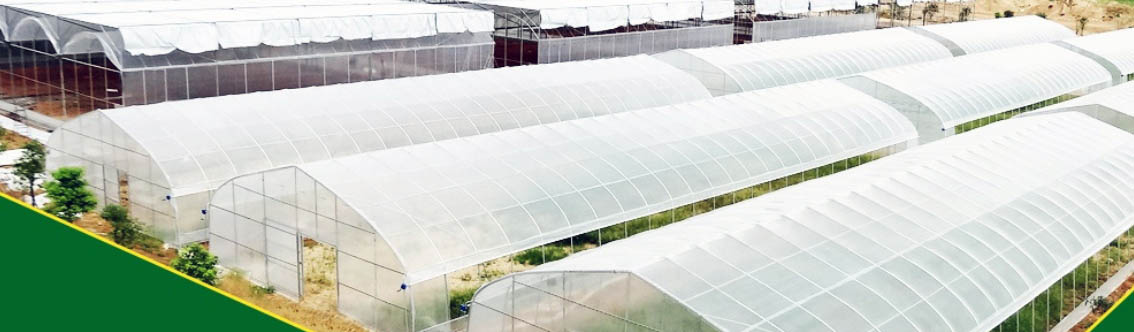
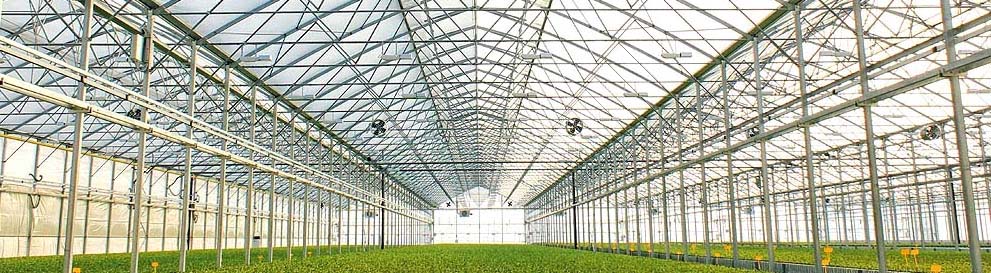
The frame is hot dip galvanized steel pipe, which is the choice that keeps a working house serviceable outdoors: the pipe is dipped rather than painted, so the coating covers the inside of the tube as well and the joints, ends and drilled holes are protected where a painted frame starts to go first. The roof is arch shaped. Over the outside of the frame sits a grooved channel that takes the film and holds it against the load a gust puts on a flat panel, which is why the covering stays in place through weather that pulls a loose sheet off its fixings.
Polyethylene film is the only covering material listed for this model, and it is held with aluminum clips. That pairing matters at the fixing: an aluminum clip seats on the doubled film where it crosses the channel, it can be re-seated by hand after a windy day, and it grips without cutting the sheet. The film is supplied in 0.12 mm and 0.15 mm, the standard clear film on the house is 6 mil, and the cover can be single or double layer, with vents operated manually or electrically.


Seedling Beds, Benches and Trays
The nursery end of a house like this is usually laid out as one length of seedling bed or bench rather than a whole bay of floor. Lifting the trays to working height does three things: it puts the plants in the brightest air in the house instead of in the shadow of the beds around them, it keeps trays off cold ground and out of standing water, and it saves the grower a day of bending over the season.
Leave a working path along the bench and do not fill the bench edge to edge. Trays need air moving between them, and the last row against a sidewall is the one that stays wet and stretches for light. The trays themselves are specified by cell count rather than by guesswork: a 32 cell seeding tray is a working size for raising on individual plants, while a higher cell count is used where the seed is sown thick and the plants are pricked out anyway. Whatever the tray, it needs to drain freely on the bench, because a tray sitting in its own runoff is how damping off starts.
The house is sized in bays rather than in benches, so the practical question at order time is how much of the floor becomes nursery and how much stays in beds. A nursery that is too large for the season is wasted heating and wasted walking; one that is too small means seedlings queue on the floor. Growers usually start with a nursery block sized to the planting programme and extend it if they take on a second cycle.
Water and Humidity Through Germination
Trays need small amounts of water often, and the seedling stage is where hand watering is most likely to go wrong in both directions: a can over a tray knocks over young stems and wets the foliage, while a missed morning can dry a shallow tray out before lunch. Irrigation ordered with the house is the usual answer, with the outlet sized for trays rather than for beds, and a greenhouse irrigation system is specified with the house so the pipe runs, valves and bench layout are drawn together instead of being fitted around each other afterwards.
The other half of watering is the humidity the house holds. Film does not breathe, so water that leaves the trays and the beds stays in the air until it is ventilated out, and humid still air at the seedling stage is what leaf disease lives in. The rule is to water early enough that the foliage dries before evening, and to ventilate in the morning so the overnight vapour leaves the house before the sun starts working on the volume.
Air and Hardening Off Before Planting Out
A seedling house is the place to build a plant's tolerance before it is planted out, and that is done with air rather than with anything bought. Vents are manual or electric, and whichever is fitted, the schedule should widen day by day in the last week or two before planting: a plant moved straight from a closed house to an open field loses leaves in its first windy afternoon. In a house run at nursery density, the workings of ventilation are worth reading up on separately, and a greenhouse ventilation layout is one of the systems that can be added to this house if the wall openings alone do not move air fast enough.
Temperature follows the air. The house effectively prevents heat loss and cold air intrusion and has good insulation properties, so a closed house carries the plants through a night that would have taken them outside, and the manual or electric openings cost little to use. The risk at the other end is the sunny morning after a cold night: a sealed house with trays in it heats quickly, and seedlings left in still hot air at midday will stretch and soften. Open on time, and let the house cool before the afternoon closes in.

The Supplies Ordered With the House
An order for this house leaves the factory in three groups: the metal structure, the covering system and the installation accessories. The film can be cut to the lengths a buyer needs for the film styles being used, so a nursery that only covers part of the house orders the covering it will actually hang instead of working around one fixed roll size. The house itself sits in the commercial film greenhouse range, which is where the other span and layer combinations are listed if a nursery block needs to be sized differently.
Beyond the house itself, the systems that can be added are cooling and heating, irrigation, ventilation, fertilization, shading and benches, and a seedling operation tends to order them in a different order from a vegetable grower. Benches come first because they set the bench layout the trays need. Irrigation comes next because the outlets are best positioned while the house is being built. Ventilation and shading follow the climate: a house in a hot, bright region needs shading over a nursery long before it needs heating, and a house in a cold one needs the reverse. Heating and cooling, and fertilization through the irrigation line, are usually added when the nursery runs outside the season the cover alone can carry.
What the House Is Used For Across the Season
Vegetables, fruit, flowers and seed nursery are the four applications listed for this house, and a seedling house usually passes through all of them in a year. In late winter and early spring it is a propagation space, holding trays of vegetables and flowers for planting out. Through the growing season the same house carries the vegetable and fruit crops it was set for, and in the flower trade it is used to keep stems cut for market out of the rain so the flowers are not marked before they are sold.
The house is described as suitable across climate conditions and adaptable to the landscape it is built on, which in practice is what makes the same model work as a nursery in a cold inland site and as a light, ventilated growing house in a hot one. What changes is not the frame but the cover specification, the layer count, and the systems ordered with it.
The crop itself is what decides the specification, so the agronomy is worth reading away from the supplier: the building and load guidance behind the figures on this page is published by the USDA, and how commercial growers manage the climate and the crops they raise under cover, from propagation through to cutting, is reported by Hortidaily.

How Long the Galvanized Frame Lasts
The frame is expected to be in service for a long time, and how long before it needs attention is decided by the air around the site rather than by the year of the invoice. Under ISO 9223 a standard galvanized coating reaches first maintenance at approximately:
- 13 years in heavy industrial air (class C4);
- 30 years in urban conditions (class C3);
- 50 years in coastal air (class C5);
- 50 years or more, with no repair needed, in clean suburban conditions (class C2).
The pipe used on this house carries a specified average coating of 70 to 85 micrometres of zinc under BS EN ISO 1461, assessed against BS EN ISO 14713-1, and the factory has been producing greenhouse frames for above 35 years. On a working house the two things worth watching are the cut ends and drilled points made on site, which should be treated after the build, and the ground contact at the base of each post, where a dry footing lasts far longer than one standing in soil or water.
Packing and Delivery
Structure, covering and accessories are packed separately, with the film kept away from bare pipe so the sheets are not scuffed in transit and the clips travelling with the parts they fit. Shipping goes to customers worldwide, and a buyer who needs the covering split from the frame, or the order divided between two sites, can arrange that when the order is placed.

The Factory Behind the House
The house comes from a manufacturer with its own frame factory, its own engineer department and its own packing and transport team, so the pipe, the film, the channel and the clips pass through one quality control rather than being assembled from several suppliers. Layout drawings and installation manuals are provided, the assigned engineer stays available while the house goes up, and engineers can travel to a buyer's country to guide the installation if that is wanted. Customers also visit the factory for cooperation discussions, and a visit can be arranged around an order. For a quotation on a seedling house, call +86 191 5068 3942 or write to sales@cngreenhouses.com.

Frequently Asked Questions
Q: Can this house be used only for seedlings?
No, seed nursery is one of four applications listed for it, alongside vegetables, fruit and flowers. The frame and cover do not change between those uses; what changes is how the floor is divided. A grower who runs a nursery in spring will usually keep beds for vegetables or flowers through the rest of the year and move the trays out as the plants are planted on.
Q: What cover does the house take, and how is it fixed?
Polyethylene film is the only covering material listed for this model, held with aluminum clips, in a single or double layer. The standard clear film is 6 mil, about 0.15 mm, and 0.12 mm is the thinner option. Over the frame sits a grooved channel that stiffens the cover where wind loads it, which is the part that keeps a large sheet of film sitting still in weather.
Q: Do I have to buy the film in a fixed roll width?
The film can be cut to the lengths needed for the film styles being used, so the covering can be ordered to suit the house and the way it is hung rather than being limited to one standard roll size. If only part of the house is to be covered at first, that can be reflected in the covering ordered. The length and quantity for a specific house are confirmed at quotation.
Q: What should be ordered with the house for nursery work?
Benches or a seedling bed first, because they set the working height and the layout of the trays, then irrigation with outlets sized for trays rather than beds. Ventilation and shading follow the local climate, since a bright hot site needs shade over a nursery before it needs heat, and the reverse applies in a cold one. Heating, cooling and fertilization are added when the nursery is run beyond the season the cover alone can carry.
Q: How long does the galvanized frame last?
It depends on the corrosivity of the air at the site. Under ISO 9223 a standard galvanized coating is expected to reach first maintenance at about 13 years in heavy industrial air (class C4), about 30 years in urban conditions (class C3), about 50 years in coastal air (class C5), and 50 years or more with no repair needed in clean suburban conditions (class C2). The pipe on this house carries a specified average coating of 70 to 85 micrometres of zinc under BS EN ISO 1461, assessed against BS EN ISO 14713-1.
Q: Are you the manufacturer, and what support comes with an order?
We are a manufacturer with our own frame factory, engineer department, and packing and transport team, and the range is produced in-house. Layout drawings and installation manuals come with the order, the assigned engineer is available for questions during assembly, and engineers can be sent abroad to guide the installation. To discuss a seedling house and the systems that suit it, call +86 191 5068 3942.
 Deutsch
 Español
 Français
 Italiano
 Português
 日本の
 한국어
 العربية
 български
 hrvatski
 česky
 Dansk
 Nederlands
 suomi
 Ελληνικά
 हिन्दी
 norsk
 Polski
 Română
 русский
 Svenska